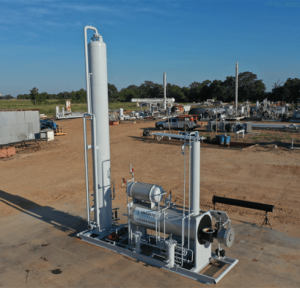
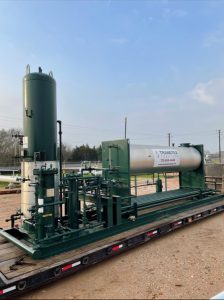
Gas Dehydration Units
TransTex keeps many sizes of Triethylene Glycol (TEG) dehydration units in our fleet to remove entrained water from the gas stream.
Contact UsYour browser is out of date.
You are currently using Internet Explorer 7/8/9, which is not supported by our site. For the best experience, please use one of the latest browsers.
TransTex keeps many sizes of Triethylene Glycol (TEG) dehydration units in our fleet to remove entrained water from the gas stream.
Contact Us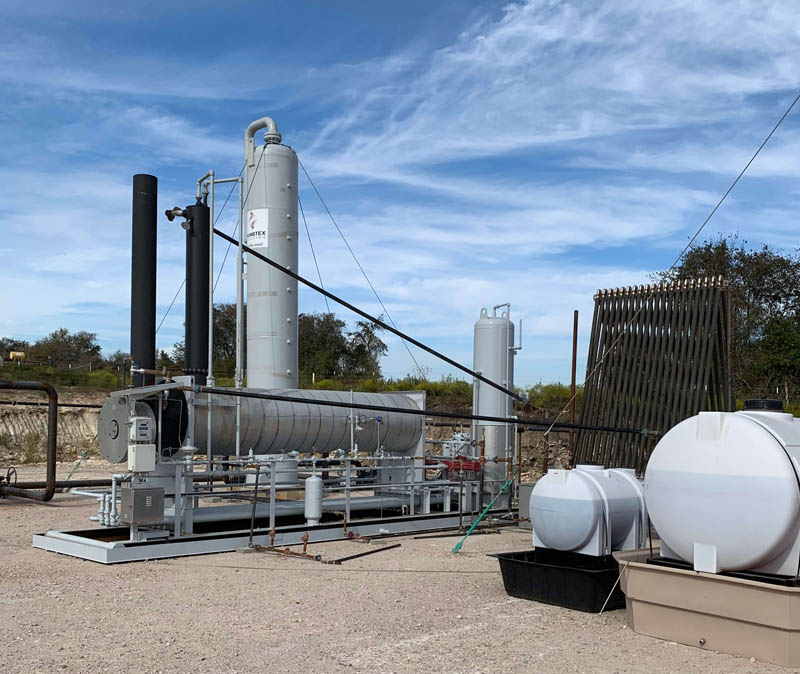

When natural gas comes out of the reservoir, it's saturated with water vapor. That water has to come out before the gas meets pipeline specifications. TransTex Treating keeps a fleet of Triethylene Glycol (TEG) gas dehydration unit equipment in multiple sizes, built at our 10-acre fabrication yard in Hallettsville, Texas, and ready for deployment across all major basins in the lower 48.
Our natural gas dehydration unit packages are modular by design, consisting of two skids: a high-pressure contactor tower skid and a low-pressure regeneration skid. This modular approach means faster mobilization, simpler installation, and the flexibility to scale as your production changes. Whether you need a 200, 500, or 750 MBtu/hr TEG regen system, we size every unit to your specific flow rates, inlet pressures, and temperatures.
In a standard TEG dehydration cycle, wet gas enters the contactor tower where it meets a stream of lean (dry) glycol. The glycol absorbs the water vapor from the gas, and the now-dry gas exits the top of the tower and moves downstream. The rich (wet) glycol flows to the regeneration skid, where a reboiler heats it to drive off the absorbed water. The regenerated lean glycol then recirculates back to the contactor.
For most pipeline sales in the southern U.S., water content specifications require levels no higher than 7 pounds per million standard cubic feet. Applications upstream of cryogenic facilities or gas plants may require further water removal to prevent hydrate formation. Our process engineers run simulations on your gas analysis to determine the right unit size and configuration for your specific conditions.


BTEX compounds and VOCs present in the gas stream are absorbed by TEG in the contactor tower and released during regeneration. Our dehydration packages include a BTEX eliminator, an atmospheric cooled heat exchanger paired with a two-phase separator, to capture these emissions. Condensed BTEX liquids route to storage, while remaining VOCs serve as fuel for the reboiler. This integrated design helps midstream operators manage emissions at the source without requiring additional third-party equipment.
By providing us with your gas specifications, our process engineers can simulate and determine what size system is appropriate for your applications specific needs. Send TransTex your gas analysis today.
TransTex offers TEG gas dehydration unit equipment for both lease and sale. Lease agreements include flexible terms and the option to modify equipment if your volumes or temperatures shift over time, giving you the ability to right-size your dehydration capacity without a long-term capital commitment. For operators who prefer ownership, we build new equipment to ASME code at our fabrication facility.
Every unit ships after a thorough QA/QC process. We also offer turnkey installation, covering upfront engineering, procurement, transportation, construction oversight, commissioning, and startup support, so your equipment is producing on schedule.
Getting the right natural gas dehydration unit starts with your gas specs. Provide us with your gas analysis, expected flow rates, inlet pressure, and temperature, and our engineering team will simulate your application and recommend the configuration that fits. Contact TransTex today to get started.

We maintain an inventory of TEG dehydration units with regeneration capacities ranging from 200 MBtu/hr up to 750 MBtu/hr. Because our units are modular, we can pair different tower and regen skid combinations to match your specific flow and water content requirements. If your application falls outside our standard inventory, our engineering team can work with you on a custom-built solution.
Yes. Leasing is one of the most common ways our customers deploy dehydration equipment. Lease agreements with TransTex include the flexibility to swap or resize equipment if production conditions change. This is especially useful for midstream operators managing declining curves or bringing new pads online in phases.
Unit sizing depends on several factors, including gas flow rate, inlet pressure, inlet temperature, and the required outlet water content specification. Higher pressures generally mean less entrained water, while higher temperatures increase the water load. Send us your gas analysis and operating conditions, and our process engineers will run a simulation to determine the right fit.
Contact our experts to learn how we provide custom and effective solutions for even your most demanding projects. Give us a call or fill out the form - one of our team members will be in touch soon.
Visit Us